Why I Added a "Explain Like I Am..." Button to Every Post
By Fabio Douek
Jump to section
Explain (TLDR) like I am...
My dad writes stuff on his blog but we don't get it. So now there's a magic button that explains everything in a way that makes sense to us! You just pick who you are and it talks to you like you're actually that person.
It's like when a grown-up uses big words and you say "huh?" and they say it again but simpler. The button does that but for everyone, even lawyers and doctors and musicians.
The author identified a gap between technical content and non-technical readership, specifically family members. The resolution was a front-matter field that stores six parallel explanations of each article, rendered client-side based on user persona selection.
From a disclosure standpoint, the same facts are presented to all readers; framing varies by persona. No content is suppressed or altered between modes. The implementation sits entirely within the author's control and carries no third-party licensing obligations.
The presenting complaint was low comprehension among non-technical family members. The author's posts were dense with jargon, which created a barrier even for motivated readers. The intervention was a persona-based summary system that delivers the same information through six distinct frames of reference.
Adherence is improved by meeting readers where they are rather than asking them to meet the content. Whether this translates to sustained engagement from the target demographic (kids, mum) is the open question. Follow-up indicated.
There is something worth sitting with here: writing about AI all day while the people closest to you have no idea what any of it means. That gap can feel lonely, like doing work that matters but not being able to share it with the people you love.
The button is a small act of translation. Not dumbing things down, just building a bridge. The fact that kids and a mum were the reason it exists says more about motivation than any feature spec could.
Every song sounds different depending on who's in the room. Play the same chord progression for a jazz head, a pop listener, a classical player, and they each hear something different. The TLDR button is just that: same melody, different arrangements.
Writing about AI is the song. The personas are the charts. Pick the one that fits your ear and the tune lands. The kids wanted something simpler; the mum wanted something she could explain to her friends. Both got their arrangement.
Retention problem: family members couldn't engage with the content. Solution: a one-click persona selector that reframes every article for six audience types. Zero extra reading required from the author post-publish; personas are written once per article and stored in frontmatter.
Adoption data is thin (sample size: two family members) but the signal is positive. Broader audiences with mixed technical backgrounds now have an entry point. The differentiator is that it's baked into every post, not a separate simplified version.
Overview
My daughters looked at me the other day and said: “Dad, I have no idea what you write about.”
My mum said the same thing, basically. She tells her friends I “do something with computers, clouds and robots” and leaves it at that.
That stung a little, honestly. I spend a lot of time on these posts. I test the tools, I think hard about the nuances, I try to write things that are actually useful. And the two people who are most invested in what I do literally cannot parse a single article.
So I built a button.
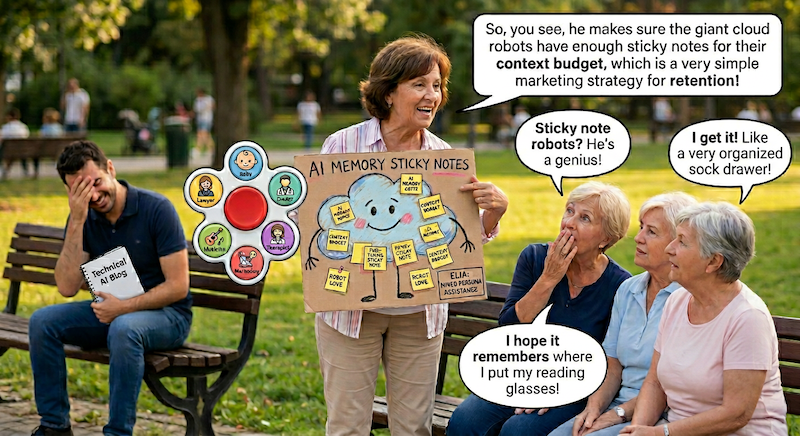
It’s called “Explain like I am…” and it sits at the top of every deep-dive blog post. You pick who you are: a five-year-old, a lawyer, a doctor, a therapist, a musician, or someone from marketing. The post explains itself to you through that lens. Same facts, different framing.
The idea is not to dumb things down. It’s to translate. Good translation respects both the source and the audience.
No need to say, these two paragraphs are AI generated. I spend a good time in writing the blogs. AI does a very good job in summarizing the overview and creating the humurous mutations.
The Problem (My Kids and My Mum, Specifically)
The thing about writing for developers and engineers is that you start assuming a lot. I write “context budget” and assume the reader knows I mean something like memory limits. I write “fine-tuning” and don’t explain that it’s basically teaching an AI model new tricks on top of what it already knows.
That’s fine for the target audience. But it completely locks out everyone else.
My kids are curious people. They want to understand what I do. They just don’t have an engineering background. My mum is smart and engaged and genuinely interested, but the language gets in the way.
The options were:
- Write two versions of every post (too much work, and one of them would always be worse)
- Write simpler posts overall (loses the technical audience)
- Build a translation layer on top of the existing posts
Option 3 is the only one that doesn’t involve tradeoffs I’m willing to make.
How It Works
Each deep-dive post now has a tldr block. It contains six short explanations, one per persona. When you land on the post, a pill selector at the top lets you choose your persona and the TLDR swaps in.
Originally the plan was just the five-year-old version. That’s the one I actually needed for my kids and my mum. But once the plumbing was in place, adding more personas was cheap, so I added the others mostly for fun. A few of them (therapist, musician) ended up being more interesting than I expected.
The six personas:
- Five Year Old: Simple. Analogies. No jargon. Assumes the reader is curious but has zero technical context.
- Lawyer: Precise. Structured. Focuses on implications, risks, and what’s actually binding vs. what’s marketing.
- Doctor: Clinical framing. What’s the presenting problem, what’s the intervention, what are the side effects.
- Therapist: Emotional and relational framing. What does this mean for the people involved? What’s the human dynamic underneath the technical surface?
- Musician: Process and feel. How does this work in terms of rhythm, composition, and collaboration?
- Marketing: Positioning and outcomes. What’s the value prop, what’s the differentiation, what does adoption look like?
What My Kids Said
I showed my daughters the five-year-old explanation for some of the posts. They read it in about thirty seconds. Then one of them said: “Oh, so it’s like the robot has sticky notes?”
Yes. Exactly. That’s it.
My mum read the marketing version of the same post and texted me: “Now I can explain this to people!” That’s the whole point.
Verdict
This is not a groundbreaking technical feature. It’s a writing commitment packaged as a UI element, with AI doing the translation work. Every post I publish gets reframed into six personas before I ship it. I write the original, AI handles the mutations.
Six explanations. One post. And now my mum can explain what I do to her friends. I hope 🙂.
That’s good enough for me.